
I am not afraid of storms, for I am learning how to sail my ship.
— Louisa May Alcott, Little Women
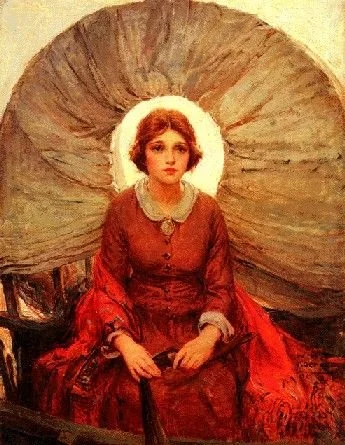
Madonna of the Prairie by W.H.D. Koerner, 1921
By the third Thanksgiving of the Great Depression in November 1932, American homemakers and the women’s magazines they read had moved through the same emotional stages as someone experiencing intense personal loss—shock, denial, anger, bargaining, and deep grief—before settling into what is often the longest phase of any traumatic event—depression. A new Democratic president-elect, Franklin Delano Roosevelt, was preparing to take office. Still, it would be a few more months before FDR’s inspiring Inaugural Address, which reminded Americans “that the only thing we have to fear is fear itself.”
Seven more lean Thanksgivings lay ahead, filled with economic uncertainty, lack, and hopelessness, followed by five years of World War. The Ladies’ Home Journal (October 1932) encouraged their readers to remember:
“When money is plenty this is a man’s world. When money is scarce it is a woman’s world. When all else seems to have failed the woman’s instinct comes in. She gets the job. That is a reason why, in spite of all that happens, we continue to have a world.”
“Once more, the job of managing the country through managing the households is up to the women. To many the job seems utterly impossible. They find themselves working against strange, unseen forces that relentlessly destroy.
“The old rules—the rules that were set to jazz by the stock sellers and the politicians simply do not fit. The thrifty are no better off than the thriftless. And so, many, trying to look forward, can see only the blackness of night…
“Nothing in the situation today is new. Nothing has happened that has not happened many times before. Nothing is abroad in our land today that was not abroad in the lifetime of the mothers and grandmothers of the present generation. Those women met and conquered conditions far worse than today’s—and without today’s resources.”
How did our grandmothers, great-grandmothers, and great-great-grandmothers face the darkness of sudden change and uncertainty over a century ago? Without realizing it, that single question has sparked my entire life’s work. When deep personal discouragement and despair hit, I find comfort in thinking of the long line of heroic women who came before me.
I call them my Mothers' Courageous—starting with the first band of Pilgrim mothers who met Native American women and shared survival skills such as farming and herbal remedies; pioneer settlers on wagon trains; enslaved African women who became proud, free African Americans; Wild West homesteaders; vibrant Latina artists; European Jewish refugees; Asian mothers crossing the Pacific; and young Irish women like my Nana Rose, carrying a baby in one arm and a suitcase in the other, fleeing Ireland’s bloody War of Independence in 1921. I think of my Kentucky granny—Lucy Eliza Lyttle Donnelly—a young widow with three children during the Great Depression—rolling out biscuit dough in her salmon-pink chenille bathrobe and marabou slippers. The world could end tomorrow, but no matter what, there would be hot biscuits for breakfast.
Each of these women faced heartbreaking reckonings and impossible survival situations. But when the darkness lifted, they dried their swollen eyes and dusted themselves off, and each of these brave and beautiful women rose to embody radiant resilience. “Helping one another is a part of sisterhood,” Louisa May Alcott reminds us, and “helping one another” reaches across time in unexpected ways.
You might be approaching this Thanksgiving with dread about the future, hidden grief for what has already happened in your life, and sorrow for what’s unfolding now. But remember: to be one woman is to be all women, and all women carry a powerful mitochondrial DNA sequence that can now be traced back to 120,000 to 150,000 years ago. It is passed down exclusively through the feminine line—daughter of Eve. I believe with all my heart that this is the genetic strand of courage, ingenuity, creativity, perseverance, and determination. And if our DNA—Destiny, Nature, and Aspirations—are Heavenly endowed, why wouldn’t we be given the spiritual strength to fulfill them?
We have. And this spiritual power is called Moxie. I want you to think of a woman’s Spiritual Moxie as an indomitable feminine strength hidden in the secret recesses of our souls; small time capsules containing the seeds of radiant resilience, restoration, and self-reliance that grow best from the fertile ashes of our previous existence, like the giant sequoia trees—the largest in the world—that reign over California forests.
The word “moxie” is a wonderful piece of early American slang—I love its lively meaning: a mix of courage, skill, nerve, and verve. It perfectly captures your dormant Mother Courage persona. Originally coined in 1885 as the brand name for a nonalcoholic health drink, “Moxie” was intended to help with whatever ailed you, especially if you were shy and modest. As we approach the holiday season and the New Year of 2027, we feel fragile, even scared. And why wouldn’t we? The past two years have been frantic and fraught, harrowing and heartbreaking, and we are frazzled to our core, worn to a raveling.
Still, Divine Grace has always known we would reach this turning point, just as our grandmothers and great-grandmothers did, for history repeats itself in cycles. It was never in doubt that women today would have to become American pioneers once again to protect and defend our precious Homefront for our children and theirs.
Accessing our Spiritual Moxie was designed for this very moment.
Think of your Spiritual Moxie as a feminine force that ignites only when two elements—boundless bravery and unwavering faith—combine. Through the spontaneous combustion of necessity and passion, they form a new compound: steely determination. Now imagine an unstoppable force meeting an immovable object. That’s the spiritual moxie of your Mother Courage, pushing through anything that stands in the way of your family’s safety, freedom, and happiness.
So, this Thanksgiving weekend, as you cook and set the table, and as you prepare to gather with loved ones and welcome friends, or to observe it quietly on your own, if anything outside triggers feelings of angst or distress, ask yourself:
Is my family safe?
Is there a roof over our heads, today?
Do I have to chop wood to keep warm?
Do I have provisions to eat and share?
Do I have to carry water from a creek three miles away in a bucket to drink, cook, clean, or bathe?
Do I have to melt snow for my water?
Will I have to make candles today before I can burn them for light?
If you can answer “No” to any of those questions —and hopefully all of us can —it’s a reminder to pause with a sigh and a smile and offer at least a simple “Thank you”—the only prayer Heaven asks of us, this or any day.
So, blessed be your giving of thanks 2026.
May Peace and Plenty always be your portion.
Dearest love to you and yours,
Sarah Ban Breathnach