On Women and the Great Vibration
“Keep quiet and say one's prayers—certainly not merely the best,
but the only things to do if one would be truly happy;
but, ashamed of asking when I have received so much,
the only form of prayer I would use would be a form of thanksgiving.”
― Elizabeth von Arnim (1866-1941)
The Solitary Summer (1899)
Dearest Friend and Reader,
I'm thinking today of the Australian-born, English novelist Elizabeth von Arnim, who intended to write a happy book when she sat down at her desk in April 1921.
Well, the truth is, she had to do it. She had just finished a dark yet cathartic novel based on her notoriously turbulent marriage to an English nobleman, called Vera. While her publishers were relieved to finally receive her long-delayed manuscript, there was a small problem. Everyone expected a lighthearted comedy, for which Elizabeth was known. Coming just after World War I ended and the Spanish Flu epidemic, the British reading public wanted to feel good again. Hopeful. She was quickly told to produce something lighter—an omelet without breaking any eggs—the happy book. Ironically, Vera would become her most critically acclaimed novel, described by the literary critic John Mansfield as “Wuthering Heights written by Jane Austen.”
Ah, the happy book.
Happiness is much harder to write about than sorrow, just as longing for love is easier to describe than its fulfillment. Still, I suspect many writers secretly wish they could write from the deep well of happiness, at least once, just to know what it feels like.
Like most authors, Elizabeth drew on personal experience in all her writing, but at this moment her inspirational bank account was overdrawn; she was physically and emotionally exhausted, needing to support herself and her five children. A lack of money can’t always muster creative attention, but it can certainly engage the will.
Thinking that perhaps a bucolic setting might inspire her, Elizabeth rented a medieval castello overlooking the Italian Riviera, a stark contrast to cold, dark, rainy London. She was optimistic after one good day, which was probably meant the lead paragraph.
It began in a woman’s club in London on a February afternoon – an uncomfortable club, and a miserable afternoon – when
Mrs. Wilkins, who had come down from Hampstead to shop and had lunched at her club, took up The Times from the table in the smoking-room, and running her listless eye down the Agony Column saw this:
To Those who Appreciate Wistaria and Sunshine. Small medieval Italian Castle on the shores of the Mediterranean to be let furnished for the month of April. Necessary servants remain. Z, Box 1,000, The Times.
With that Lord Have Mercy lead, the next morning, Elizabeth came to a complete stop. Her diary entry from April 3, 1921, notes: “Staring open-mouthed all a.m.” Although hope was blooming outside her window in the warmth of an Italian spring, it was beyond her reach as a writer, just as love had been.
Often, writers cast their words prophetically, like a sorceress might cast a spell. Many times, when those words come back to you between two covers, your ghostly specter is so fully fleshed that you no longer recognize your own creation. Keep in mind, Mary Shelley did not know she was creating Frankenstein in 1818 when she wrote, “Thus strangely are our souls constructed and by such slight ligaments are we bound to prosperity or ruin.” The woman started off writing a love story.
When I worked as a journalist, always on deadline, I was fortunate to have a tough editor (though, if I recall correctly, I didn't see it as a blessing at the time). Deadlines are brutal. Column inches are crippling. Once, only once, I blamed writer’s block for my delay in submitting a piece. My editor looked up and stared me down in one long, withering glance of utter contempt: “Writer’s block? Lazy writers not telling the truth. Forty-two minutes, 750 words.” Only by the grace of God did I finish it. But I’ve never forgotten the mystical equation: Writer’s Block? Not telling the truth.
Now, when I read something I’m in the process of writing, and suddenly, I start to weep, I know I’m close. Unintentionally, my subconscious scrawl has hit a psychic sciatic nerve, and I have no choice but to keep going. “The line of words fingers your own heart” is how the luminous Annie Dillard describes the process. “It invades arteries and enters the heart on a flood of breath; it presses the moving rims of thick valves; it palpates the dark muscle…feeling for something, it knows not what.”
As I knead my own nerve slowly, I chance upon a gnarled ganglia from the past—suppressed memories, calcified regrets, shards of remorse, a cyst of shame—entangled and embedded in a hard, painful knot, hidden deeply in my heart’s cavity. I tap the keys, my prose probing too close for comfort, much the way a doctor taps her fingers upon the body to sense the condition of an organ through sound. Something I’ve not been ready to acknowledge, some reckoning I’ve been resisting, is struggling to be heard.
But I can feel it beneath my feet, the Deeper Vibration. The truth that Divine Change is on her way. You’ve heard it too. That’s because Divine Change is vibrational. We’re only gaslighting ourselves into believing that change appears out of nowhere.
There is nothing erratic, irrational, or random about change. As regular as the ebb and flow of the tides, the recurring sequence of the four seasons, the monthly phases of the moons, menstruation, and menopause, the cycles of sowing and reaping, and the daily progression from day into night, change can be counted on. And if you allow yourself to be still enough, you can even hear change approaching.
More often than we realize, change arrives softly, a gentle whisper meant to ease our doubts and even inspire us to begin making subtle course corrections in certain situations. We don’t. So, change becomes a recurring theme in our lives, a pulsating riff, the same issue wrapped in different circumstances. For example, in one month, you lose your keys, your job, your lover, your wallet, your lease. Hang on, what’s happening here? What situations in life have you been dragging your heels about; what are you ducking that you should have ended long ago? Or what don’t you believe you deserve? What is it you fear someone will take away? Security. Safety. Serenity. Love. Money. Health. Happiness. Your husband. Home. Everything?
Loss is trying to get your attention before Divine Change gets into town.
Yes, the world is frightening and seems to become more so each day. We are exhausted from tossing and turning, to-ing and
fro-ing. We are worn to a raveling by the chaos surrounding us. The sharp words that pop out of nowhere. The short fuse when inarticulate irritation becomes sudden rage. We are annoyed, anxious, and angry because nobody seems to be in charge of anything. Our emotional equilibrium is continually in free-fall. It’s impossible for us to be “steady as she goes.”
But here is what I’ve learned and share with the seeker in you. Being scared is a sacred warning signal triggered to keep you and yours out of harm’s way. Just change the positions of the letters “a” and “c,” and “scared” becomes “sacred.”
Being scared is a primal instinct that keeps you alive in dangerous situations until you can get the hell out of them. Think of it as a spiritual shortwave radio frequency processed through a woman’s sixth sense—your intuitive sense of Knowing. The more scared I am of a flashpoint, the more urgent it is for me to stop, take a deep breath, exhale, and face it. I might not know where the hatches are that I’ve just been told to batten down, but I will find them. My spirit animal these days is the mother prairie dog, poking her head out of the burrow, instinctively measuring the vibrations of miles to minutes before the buffalo stampede. She doesn’t ignore the Deeper Vibration, and neither can we.
Our souls' prime directive is to become the calmest, most capable woman in any challenge, crisis, or circumstance racing towards us. The more confusion that surrounds us, the calmer we become—anyplace, anytime, anywhere. And notice all those different words that begin with the letter “C”. Interesting.
We can do this. We can handle whatever needs to be done today and tomorrow. Keeping a Gratitude Journal is wonderful if you can, do, or will do again, because recording remembered blessings is the foundation for contentment. But more urgently, we can rise to the occasion with the passionate power of gratitude at this moment, through a daily litany of “Thank you”. Softly, under your breath.
Thank you for protecting me from what I didn’t need to know at the time. Thank you for finding a way when there seemed to be no way. Thank you for helping me from falling. Thank you for helping me get back up. Thank you, I was able to find the pilot light. Thank you for the cat food and litter that arrived. The 13th-century German mystic Meister Eckhart said, “If the only prayer you say in your entire life is 'Thank you’, it will be enough,” and he was right. In the morning, when you open your eyes and take a conscious breath, give thanks for another day—another breath.
Then, ask Heaven for a day’s worth of Grace to guide and protect you and yours. Throughout my life, the prayer for one day’s portion of Grace has always been answered, and I am always stunned when I forget this, and I do. For here is the most powerful truth of all: Divine Grace always overrules natural law.
Does this mean that this invocation will stop the tornado in its tracks? No. But Mother Courage will help you in some other way that day.
Let’s hold this thought: Divine Grace always overrules natural law. Still, here’s the little print of life: Divine Grace can’t intervene if we don’t ask for it. This is spiritual law. As above, so below. We must ask for help. (June 6 Simple Abundance. Ask, Ask, Ask.) We have not, because we do not ask.
One day’s portion of Grace. Of course, we don’t know what Grace will look like, but the angels do. And at the end of the day, you will have another unexpected blessing to be grateful for as you close your eyes.
After it was published in 1922, The Enchanted April was hailed as a “delicious confection” capable of working its magic on all.” No one was more surprised than its author. Luckily for the rest of us, the result of Elizabeth von Armin’s struggle to describe happiness can be a restorative remedy.
Her deeply moving novel about four very different women, each miserable in her own way, who are drawn back to Life through the magic and romance found in what had been dismissed as “ordinary,” reveals feminine truth—that no life is beyond the redemptive love of a good woman—especially her own. But knowing how Elizabeth von Arnim created it, through racking sobs, makes me appreciate the gift and its giver so much more.
The comforting spring ritual of watching the movie The Enchanted April (1991), or the combination of reading and then viewing—even if you think you’ve seen it before—will surprise you. When I first saw the film, I was married, and I responded to its message like a plant leaning toward the light. Years later, when I was no longer married, watching the movie was more difficult, and I had to watch it over a couple of days. Why? Because I realized that although my domestic situation had changed, my pattern of overloading others' needs onto my daily routine had continued, and my frequent backaches were a clue. The Deeper Vibration felt fainter than my pulse. Now, watching it feels frothy, delightful, and soothing—subtle and sublime. The story remains the same, but I am not the woman I was. How about you?
Sending you and yours dearest love and blessings on your courage,
Sarah Ban Breathnach
Swell Dames Circle for March replay available
She Was Her Own Greatest Mystery!
Agatha Christie and The Mystery of a Happy Life
"Nobody in the world was more inadequate
to act the heroine than I was." --Agatha Christie
For over 60 years, Agatha Christie perfectly played the little old lady who wrote cozy mysteries when not
knitting or gardening. But behind her 66 detective novels, 15 short-story collections, 16 plays, and 6
Romance novels under the name Mary Westmacott lived a thoroughly modern woman who sailed around
the world, loved fast cars, surfing, and archaeology digs.
Listen to Sarah Ban Breathnach as she discusses the hidden clues that helped Agatha Christie create a beloved old lady public persona
and a happy private life.
THE WORLD NEEDS DREAMERS AND THE WORLD NEEDS DOERS. BUT ABOVE ALL, THE WORLD NEEDS DREAMERS WHO DO.
― SIMPLE ABUNDANCE: A DAYBOOK OF COMFORT AND JOY
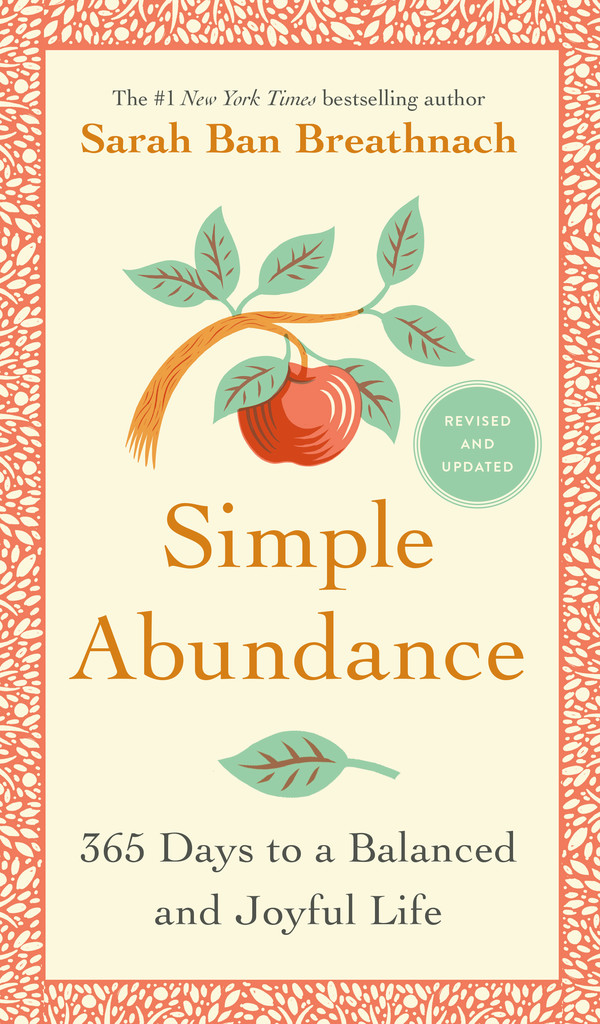
SIMPLE ABUNDANCE
Updated and Expanded
THE PERENNIAL CLASSIC WHOSE TIME HAS COME AGAIN
Women read Simple Abundance then give the book to 10 friends because it rings so true.
-Time Magazine
Sarah Ban Breathnach might be described as the Isaac Newton of the simplicity movement.
-Sunday Telegraph (London)
Sarah Ban Breathnach speaks to the very soul of frazzled modern women who suffer from a lethal surge of impossible expectations.
-USA Today
THE SIMPLE ABUNDANCE JOURNAL OF GRATITUDE
NOW REVISED FOR A NEW GENERATION!
AVAILABLE NOW
Originally published in 1996 as a companion to the worldwide phenomenon Simple Abundance, this ground-breaking journal created by bestselling author Sarah Ban Breathnach introduced the now wildly popular concept of the gratitude journal. Sarah was at the forefront of the movement recognizing Gratitude’s ability to bring healing, joy, authenticity, balance and wholeness into our lives, and thus opened the door for scientists, spiritual leaders, and life-style experts to extoll its virtures.
THE BEST PART OF THE DAY
The Best Part of the Day teaches the life affirming philosophy of gratitude found in Simple Abundance to children. The wonderful result is a shared experience of gratitude when The Best Part of the Day is read to a child by a loving adult.
-Midwest Book Review
Many women exclaim how Simple Abundance changed their lives; The Best Part of the Day will bring this same life-changing message to their children and grandchildren.
-Howling Horn blog
This new children’s book proves itself to be one of those books; the books that are stuck in our memories because they were our favorites to hear and see when we were growing up. This is not an exaggeration, either. This story is all about seeing the world and being thankful for it.
-Feathered Quill Book Reviews